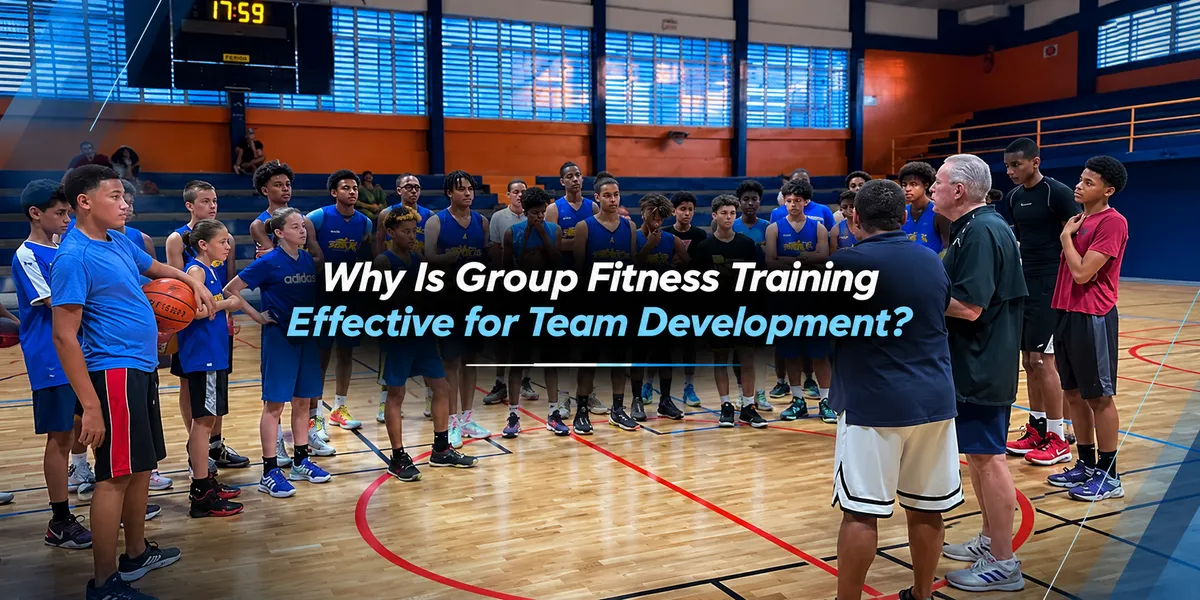
Why Is Group Fitness Training Effective for Team Development?
Most coaches know the feeling: a roster full of talented individuals who still can't play like a unit. Group fitness training closes that gap in a way individual drills never quite can, because it forces players to communicate, push through fatigue together, and hold each other accountable in real time. When conditioning happens as a group instead of in isolation, the physical gains show up alongside something harder to coach: trust between teammates.
Explore Group Training & Team Sessions
See how structured team sessions can support conditioning, communication, defensive habits, and shared accountability.
Explore Group Training →What Makes Training in a Group Setting Different From Solo Conditioning
Shared Effort Changes How Players Respond to Fatigue
A player running sprints alone will often ease off once nobody's watching. Put that same player in a group setting, and the pace changes almost immediately. Teammates naturally push each other through the last few reps, and coaches see fewer players coasting through a set. This isn't just motivation talk - it's a pattern that shows up consistently once teams shift from solo conditioning to structured group training sessions built around the whole roster instead of individual workouts.
It Builds Communication Under Physical Stress
Basketball, like most team sports, demands communication when players are tired, not just when they're fresh. Sessions that combine conditioning with live reps teach players to call out screens, rotations, and switches while their legs are burning. That's a very different skill than communicating during a slow-paced walkthrough, and it only develops under real physical load. Teams that skip this step often look sharp in practice and fall apart defensively in the fourth quarter, once fatigue exposes the gaps.
The Peer Pressure Effect, Used Well
There's a version of peer pressure that hurts a locker room, and a version that builds it. Conditioning as a unit channels competitiveness toward a shared goal instead of individual stats. Players start holding each other to the pace the group has already set, which is a far more durable habit than anything a coach can enforce from the sideline alone.
What Structured Group Training Can Reinforce
Group sessions work best when physical conditioning, communication, skill development, and team expectations all support the same goal.
How Structured Training Programs Support Long-Term Team Development
Consistency Across a Roster
One of the harder problems for any program is getting fifteen players to the same physical and mental baseline. Well-designed training programs that run the whole roster through the same conditioning blocks make it far easier to spot who's falling behind early, rather than discovering the gap in week six of the season. It also gives coaches a shared vocabulary for effort and pace that every player on the roster understands, which cuts down on the confusion that comes from inconsistent expectations.
Group Sessions Still Need Individual Attention
Team development doesn't mean every player gets identical instruction. The strongest programs pair group conditioning with periodic one on one personal training to correct footwork, stance, or specific weaknesses that tend to get lost in a group setting. Coach Gibbons has built the Gibbons & Gibbons Academy approach around exactly that balance, using group sessions to build team cohesion while reserving individual work for the technical details that separate a good defender from a great one.
Tracking Progress Without Overcomplicating It
Programs don't need elaborate testing protocols to know whether conditioning is working. Simple, repeatable benchmarks - sprint times, defensive slide drills, recovery between sets - give coaches a clear read on whether the group is progressing as a unit. The key is repeating the same benchmarks over time rather than switching drills so often that nobody can tell if the team is actually improving.
Explore One-on-One Personal Training
Use individual coaching to target footwork, stance, technique, and specific player weaknesses that may be harder to address during full-team sessions.
View One-on-One Training →Where Group Training Fits Into a Full Program
Pairing Conditioning With Strategy
Physical conditioning on its own only gets a team so far. Programs that combine group sessions with regular coaching calls & strategy consulting tend to see faster improvement, because players connect the physical work directly to the schemes they're being asked to execute. Conditioning without context is just fatigue; conditioning tied to a defensive system is preparation that actually shows up on game night.
Building an Identity, Not Just Fitness
Teams that train together regularly start to develop an identity that outlasts any single season. Players who've sweated through the same conditioning blocks tend to hold each other to a higher standard during games, since they've already proven to one another that they'll push through discomfort as a group. That kind of culture rarely comes from talent alone, and it's a big part of what programs are really paying for when they invest in structured team training rather than piecing together drills on their own.
A Note on Program Buy-In
None of this works if players see conditioning as punishment rather than preparation. Coaches who frame group sessions as part of a shared goal, rather than a consequence for a bad practice, tend to get far more buy-in over the course of a season.
Explore Coaching & Strategy Consulting
Build a clearer connection between how your athletes train and the defensive systems, assignments, and game plans they're expected to execute.
Explore Strategy Consulting →Recovery and Injury Prevention in a Group Setting
Why Recovery Planning Matters More With Group Volume
Conditioning as a team means everyone is absorbing similar volume at similar times, which raises the stakes on recovery planning. A program that pushes hard group sessions without building in rest days or lighter recovery blocks tends to see fatigue-related injuries climb as the season goes on. Coaches who track soreness and energy levels across the roster, even informally, catch these patterns before they turn into missed games.
Adjusting for Players Coming Back From Injury
Group sessions can be harder to scale for a player working back from an injury than individual work is. Programs that handle this well usually build in modified tracks within the same session, so a returning player can still take part in the team environment without being pushed past what their recovery timeline allows. This keeps injured players connected to the group instead of isolated during a period when team culture matters most.
Getting Started With a Group Training Approach
Programs interested in building this kind of foundation don't need to overhaul everything at once. Most schools start with a short evaluation period to see how the current roster responds to group fitness classes before scaling up to a full season plan built around structured, repeatable training.
Training in a group setting won't replace individual skill work, and it shouldn't try to. But for teams that struggle to translate individual talent into on-court cohesion, it's often the missing piece between a roster of good players and a team that actually plays like one.
Explore Gibbons & Gibbons Academy Services
Compare team training, personal sessions, strategy consulting, recruiting support, and other development options for your athletes or program.
Explore All Services →FAQs
1. How is group fitness training different from regular team practice?
Team practice usually focuses on plays and scrimmage situations, while group fitness training centers on conditioning, effort, and physical accountability as a unit. The two work best together rather than as substitutes for each other.
2. Can group training work for younger or less experienced teams?
Yes, though the pace and intensity usually need to be scaled down. Younger teams often benefit even more from the communication and accountability habits that group conditioning builds early on.
3. How often should a team do group conditioning sessions?
Most programs run group sessions two to three times a week during the season, with adjustments based on game schedule and recovery needs. In-season volume should always account for game-day fatigue.
4. Does group training replace the need for individual coaching?
No. Group sessions build team cohesion and shared conditioning standards, but individual weaknesses in footwork, stance, or technique are usually best addressed through one on one personal training alongside the group work.
5. What results should coaches expect from consistent group training?
Beyond improved conditioning, most coaches notice better in-game communication, less finger-pointing during tough stretches, and a roster that responds more consistently to defensive assignments under pressure.
6. How do training programs account for players at different fitness levels?
Well-designed training programs group players by baseline fitness where possible and build in progression points so less-conditioned players can catch up without being left behind or overworked early on.
