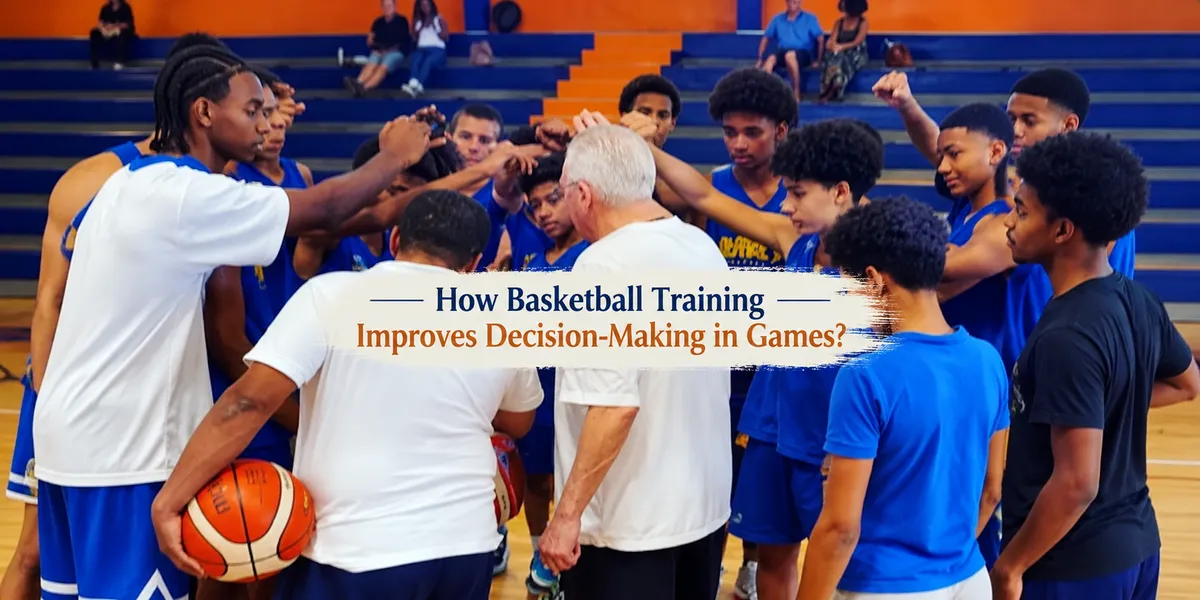
How Basketball Training Improves Decision-Making in Games?
Anyone who's watched a youth basketball game has seen it: a kid drives into three defenders instead of kicking the ball to a wide-open teammate, or freezes for a half-second too long on a fast break. Parents often wonder if that's just a natural feel for the game that some kids have and others don't. It isn't. The right basketball training can teach a player to read a defense, process options faster, and make better choices under pressure, the same way it teaches a jump shot or a crossover.
This isn't about memorizing plays. It's about building the instincts that let a player see the game a half-step ahead, and knowing how that training actually works can help you see the value in it.
Explore Game Planning & Scouting
Help your athlete learn how to recognize tendencies, understand matchups, and walk into games with a clearer plan.
Explore Game Planning →How Basketball Training Builds Decision-Making
Coaches sometimes call it basketball IQ, but that name is a little misleading. It sounds like something a player either has or doesn't, when really it's built the same way any other skill is: through repetition, feedback, and enough game-like situations that the right choice starts to feel automatic. That's the real goal of basketball training that focuses on the mental side of the game, not just the physical one.
Reading the Defense
A lot of decision-making comes down to recognizing patterns before they fully develop. Is the defender playing off, daring a jump shot? Is help coming from the weak side? Drills that isolate these reads, over and over, teach players to recognize them in real time instead of figuring it out after the play is already over.
Reading Teammates and Spacing
Good decisions also depend on knowing where four other players are without staring at them. Spacing drills and small-sided games force players to feel the floor, so a pass to the corner or a drive to the rim becomes a reaction instead of a calculation.
Four Ways Players Learn to Read the Game Faster
The mental side of basketball develops through different training environments that reinforce one another.
How Game Planning and Scouting Build Smarter Players
One of the fastest ways to sharpen decision-making is to take some of the guesswork out of the game itself. Game planning and scouting sessions teach players to study an opponent before they ever step on the court, so decisions during the game are informed instead of purely reactive.
Studying Tendencies Before the Game
Knowing that an opponent's point guard always drives left, or that a team struggles to defend the pick-and-roll, changes how a player approaches the first few possessions. Instead of feeling the game out for a full quarter, they start making sharper choices from the opening tip.
What Players Take Away From a Scouting Report
A useful scouting report isn't just a stack of stats. It highlights two or three things a player can actually use in the moment, like a shooter to close out on hard, a set play to expect out of a timeout, or a matchup worth attacking. Keeping it simple is what makes it usable mid-game.
Explore Group Training & Team Sessions
Give players more chances to read teammates, defenders, spacing, and pressure in a live training environment.
Explore Group Training →Training Environments That Force Real Decisions
Decision-making doesn't improve much standing in a line, waiting for a rebound drill. This kind of basketball training works best in situations that force a player to choose, quickly, with real consequences for guessing wrong.
Live Team Sessions
Group training sessions are where a lot of this comes together. Small-sided scrimmages and live defensive drills put players in situations close to an actual game, where they have to read, decide, and execute, all within a couple of seconds. There's no pausing to think it through.
Individual Reps Under Pressure
That said, some decisions are easier to isolate one-on-one. Personal training sessions let a coach slow a specific moment down, like a closeout or a pick-and-roll read, and walk through it until the right choice starts to stick on its own.
Explore One-on-One Personal Training
Work directly with a coach to isolate specific reads, techniques, and decision-making situations that need more focused repetition.
View One-on-One Training →How Coaches Shape Decision-Making On and Off the Court
A coach's own playing and coaching background shapes how they teach this stuff, more than most parents realize. At Gibbons & Gibbons Academy, that background includes real Division 1 coaching experience, which tends to produce a different kind of teaching than a coach who has only worked with younger age groups. Players get taught the same reads used at higher levels of the game, not a simplified version of them, and that difference shows up in how quickly good decisions become second nature.
That teaching doesn't stop when practice ends. Coaching calls and strategy consulting give parents and players a chance to talk through specific in-game moments, like a hesitant possession late in a close game, and work out what a better decision would have looked like.
Why Strong Decision-Making Matters Beyond This Season
Basketball IQ tends to matter more as competition increases. A player who can score but can't read a defense or find the open man often stalls out at higher levels, while a player who makes consistently smart choices keeps getting opportunities, even when they're not the most athletic person on the floor.
This is part of why recruiting support conversations often circle back to decision-making specifically. Coaches at higher levels can teach athleticism up to a point, but they're looking for players who already understand how to play the game the right way.
Signs Your Child's Decision-Making Is Improving
This kind of progress can be harder to spot than a higher scoring average, but there are a few tells worth watching for. Your child starts making the simple pass instead of forcing a tough shot. They communicate on defense before a mistake happens instead of after it. Their coach starts trusting them with the ball in close situations, which usually says more than any stat line.
A rising basketball IQ often shows up in what a player stops doing as much as what they start doing: fewer panicked turnovers, fewer bad shots taken just to end a stressful possession, fewer moments of hesitation when the game speeds up.
Decision-making is one of those skills that's easy to overlook because it doesn't show up on a stat sheet the way points or rebounds do. But it's often the real difference between a player who plays hard and a player who plays smart. If you want to see what that kind of basketball training looks like for your child, a conversation with a coach is a good place to start.
Explore Coaching Calls & Strategy Consulting
Review specific game situations, talk through decisions, and help your athlete understand what to look for the next time the same moment happens.
Explore Strategy Consulting →FAQs
1. Can decision-making really be trained, or is it natural talent?
It can absolutely be trained. Some players pick it up faster than others, but pattern recognition and quick decision-making improve with repetition and the right kind of practice. Most of the improvement comes from being put in realistic situations often enough that good choices start to feel automatic.
2. What age is best to start working on basketball IQ?
There's no single right age, but many coaches start introducing basic reads, like recognizing an open teammate, around middle school. Older and more advanced players can handle more complex reads, like exploiting a mismatch or recognizing a defensive rotation. Training usually adjusts to whatever level a player is already at.
3. How is decision-making training different from regular skills training?
Skills training usually focuses on mechanics, like shooting form or a dribble move, done in a controlled setting. Decision-making training adds pressure and choices, asking a player to pick the right skill at the right moment. Both matter, and most good programs blend the two.
4. Does watching more basketball help a young player's decision-making?
It can, especially when a young player watches with some guidance about what to look for, like spacing or defensive rotations. Passive watching helps less than watching with a specific question in mind, such as why a player chose to pass instead of shoot. Coaches can help point out what to notice.
5. How can I tell if my child's coach is actually working on this?
Look for training that includes live, game-like situations, not just repetitive individual drills. Ask whether sessions include any discussion of why a certain choice was right or wrong, not just what happened. A coach focused on decision-making usually explains the reasoning behind a play, not just the mechanics of it.
6. Will better decision-making actually show up in game stats?
Sometimes, but not always in obvious ways at first. It often shows up as fewer turnovers and smarter shot selection before it shows up as more points or assists. Over time, players who make consistently good decisions tend to see their overall stats improve as a result.
